
WhatsApp and Encryption: The Business Gap Most Teams Miss
What WhatsApp Encryption Actually Means
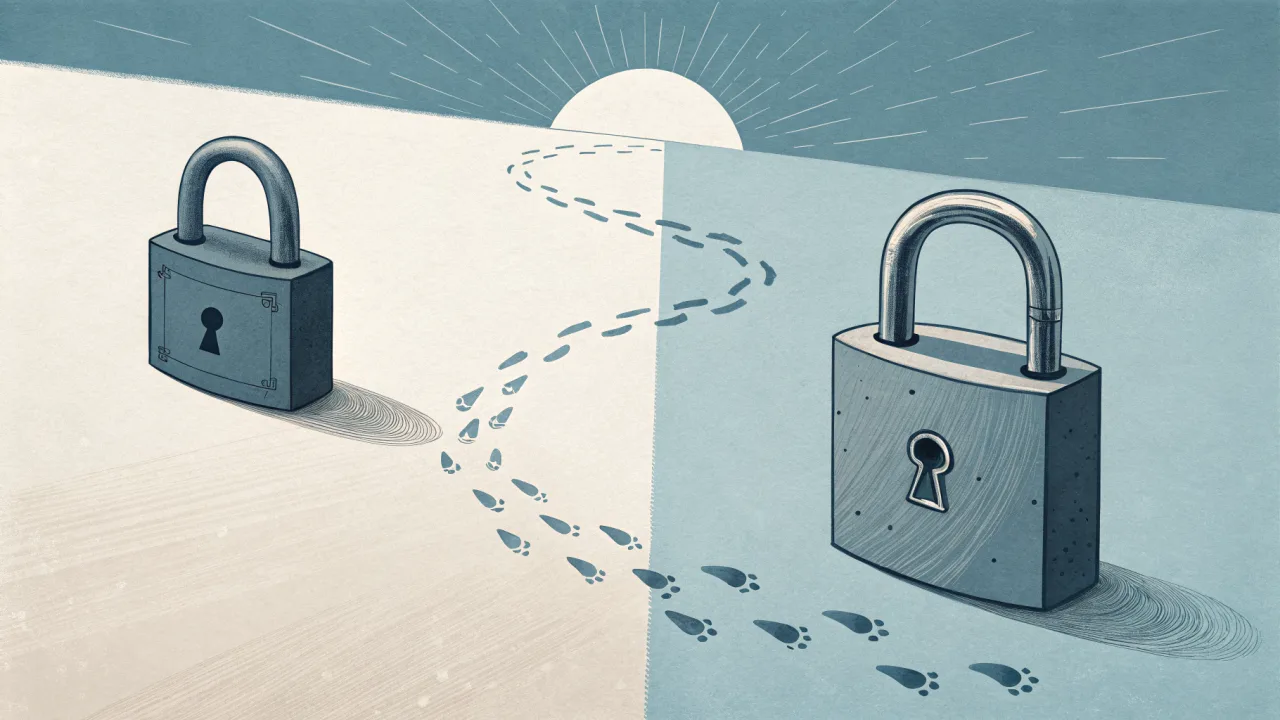
WhatsApp and encryption go together by default: the app applies end-to-end encryption (E2EE) built on the Signal Protocol, so only the sender and the recipient can read messages, not WhatsApp, not Meta, and not anyone intercepting data in transit. E2EE covers personal chats, group messages, voice calls, and video calls automatically, with no setup required.
Most teams stop at that sentence as if it settles the subject. It does not. The definition tells you what is protected, and what is protected is narrower than most businesses believe.
The part that almost never gets explained is the boundary line. E2EE protects message content while it moves between two devices. It says nothing about metadata, cloud backups, or what happens when a business sends those same messages through the WhatsApp Business API.
Here is the claim this article defends: WhatsApp's cryptography has never been the weak point. The gap between consumer end-to-end encryption and how the WhatsApp Business API actually routes messages is where the real business risk lives.
The Scope and Limits of the Encryption Guarantee
Content is encrypted. Metadata is not.
End-to-end encryption secures the body of a message: the words, the media, the attachments. What it does not secure is the context around that message. The sender, the recipient, the timestamp, and how often you contact a particular person are all visible to WhatsApp and Meta.
This is the single most misunderstood fact about the product. A customer can message you about a sensitive order issue, and the content of that conversation stays private between their device and yours. Meanwhile, the fact that they messaged you at 2:14 PM on a Tuesday, from a specific region, three times this week, sits in WhatsApp's telemetry.
Privacy researchers have emphasized this limit repeatedly: encryption of content does not mean privacy of behavior. For a business, the practical consequence is that you should never treat "WhatsApp is encrypted" as equivalent to "our customer conversations are confidential."
The WhatsApp Business API does not inherit consumer E2EE.
This is the gap that matters most for the people reading this article. Consumer WhatsApp, the app on a personal phone, is end-to-end encrypted. The WhatsApp Business API, the channel businesses use for marketing and support at scale, is a different architecture.
The API routes business messages through Meta's servers, and the platform provider the business uses to send those messages can read the content by design. That is not a flaw; it is how the system is built. It is how automated replies, chatbots, and shared team inboxes work at all.
The Business API is also the channel governed by Meta's template approval, messaging window rules, and consent requirements. We have covered those compliance mechanics in depth in our guide to safe bulk messaging. The encryption point is simpler: if you send through the API, your provider sees the conversations.
Privacy policies govern metadata, not message content.
WhatsApp's privacy policy, including its India-specific variant, governs how metadata and business data are handled and shared with Meta's family of apps. The India version has drawn regulatory scrutiny over data-sharing arrangements. Those are data-governance questions, not cryptographic failures.
The distinction matters for compliance. If you operate in India under the DPDP Act or in Europe under GDPR, your obligation is to understand what your platform provider does with message data, not to assume E2EE resolves the question.
How WhatsApp's End-to-End Encryption Works
The Signal Protocol and key exchange
WhatsApp's E2EE is built on the Signal Protocol, the same cryptographic framework used by Signal. The protocol's design has been published and examined widely in the security community, which is precisely why it is trusted.
The mechanism works through asymmetric key pairs. Each device generates a public key and a private key. The public key is uploaded to WhatsApp's servers so other people can find it; the private key never leaves the device. When you message someone, your device uses their public key to encrypt the message, and only their private key can decrypt it.
This is why WhatsApp itself cannot read the content. The servers hold public keys, not private ones. Even a compelled server cannot decrypt a message it never had the means to unlock.
Perfect forward secrecy
WhatsApp's system uses perfect forward secrecy, meaning a new session key is generated for each messaging session. If one session key is compromised, an attacker cannot use it to decrypt past or future conversations.
This is a meaningful property. It means the damage of a single compromised session stays contained. For businesses running support or sales conversations, the practical takeaway is that a breach in one channel does not cascade into every historical chat.
End-to-end encrypted backup: the on or off trade-off
Cloud backups are where the encryption model gets genuinely confusing. By default, WhatsApp backups to Google Drive or iCloud are not end-to-end encrypted; the cloud provider technically has access. You can turn on end-to-end encrypted backup, which generates a 64-digit key or lets you set a password.
The trade-off is stark. With encrypted backup on, only your key unlocks the data, and if you lose the key and your device, the backup is unrecoverable. With it off, the backup is recoverable but the cloud provider is in the chain of trust.
Most people never touch this setting. For a business that stores customer conversation history as a record, the choice has real compliance weight. An unrecoverable backup is a data-retention failure; an unencrypted one is a confidentiality gap. Pick deliberately.
Enabling and Managing Encryption Settings in WhatsApp
Verifying encryption on a specific chat
Consumer WhatsApp does not let you turn the core encryption on or off, but it does let you verify that a conversation is actually protected. The verification procedure works step by step:
- Open the chat you want to check and tap the contact's name at the top of the screen.
- Tap Encryption to view a 60-digit security code and a matching QR code.
- Compare the code with the other person in person or over a separate channel; if the codes match, the conversation is end-to-end encrypted and no man-in-the-middle is present.
That last comparison step is the part people skip. Verifying the code in the app only matters if you confirm it through a channel the other person actually controls.
Encrypted cloud backup: password or key
Enabling encrypted backup follows the same sequential shape:
- Open Settings, then Chats, then Chat Backup.
- Tap End-to-end Encrypted Backup and turn it on.
- Choose a password or a 64-digit key, confirm the choice, and then verify it afterward so WhatsApp can prove the key works.
The verify step exists so you cannot lock yourself into an unrecoverable backup by accident. Choose a password you can actually remember, or store the key somewhere your team can retrieve it without defeating the purpose.
Why you cannot disable message encryption in WhatsApp
A common search asks how to disable end-to-end encryption in WhatsApp, and the honest answer is that you cannot. Message E2EE is on by default and is not user-configurable. The only encryption toggle available is the one for cloud backup.
There is a legitimate version of this question for businesses. When you move to the WhatsApp Business API for sales or support, the conversations are no longer end-to-end encrypted between the business and the customer. That is the architecture we discussed above, and it is the reason vendor choice matters.
Evaluating Encrypted Messaging Platforms for Business
If you accept that the Business API is not E2EE, the next question is what to look for in the platform you use to send messages through it. The encryption narrative, when applied to a Business API provider, reduces to a set of concrete dimensions you can audit.
| Dimension | What good looks like | Why it matters |
|---|---|---|
| API type | Official WhatsApp Business API only | Unofficial or grey-market APIs risk bans and have no Meta support |
| Data residency | Clear statement of where message history is stored | GDPR, India's DPDP Act, and sector rules may require jurisdictional control |
| Metadata handling | Logs of volume and timing are defined and bounded | Even with E2EE on the consumer side, the provider sees conversation content |
| Encryption at rest | Stored messages and attachments are encrypted, not just transit | Protects history if the provider's storage is compromised |
| Access controls | Role-based permissions limit who reads which conversations | Not every agent should see every chat |
| Compliance docs | A signed data processing agreement is available | You need it to satisfy your own regulatory obligations |
| Cost model | Per-message pricing aligned to actual volume | Per-seat models charge for idle agents; per-message scales with usage |
The platform type is the first filter. The official WhatsApp Business API is the only compliant path and the only one Meta supports for business messaging at scale. Anything unofficial is a ban risk, and we have written about why that matters for teams running automated replies.
The cost dimension deserves more weight than it usually gets. Per-message pricing ties your spend to real conversation volume, which is predictable for marketing broadcasts and support flows alike. Per-seat models charge you for every agent regardless of how many chats they actually handle.
The Encryption Misconceptions That Create Business Risk
The first misconception is that E2EE equals total privacy. A business that assumes its customer chats are fully private from Meta is wrong. Metadata flows regardless, and that metadata can include sensitive signals about your customer base and their behavior.
The second is that the Business API inherits consumer encryption. It does not, and teams that discover this mid-deployment tend to discover it in the worst way: during a compliance review. The architecture is transparent if you ask the question before you build.
The third misconception sits inside the encryption scandal debate. A lawsuit alleged that Meta could access virtually all WhatsApp messages despite advertising end-to-end encryption. Meta denied the accusation. What actually happened is that the dispute is about metadata and data-sharing with Meta's broader infrastructure, not about the Signal Protocol being broken.
Security literature has examined WhatsApp's E2EE deployment and its surrounding limitations extensively. The consistent finding is that the cryptography holds, while the adjacent systems, metadata handling, backup defaults, and account recovery paths, carry the real exposure.
The India privacy policy angle follows the same pattern. Regulatory scrutiny there targets how WhatsApp shares data across Meta's family of apps. That is a data-governance dispute about what happens around encrypted messages, not evidence that encryption itself failed.
When the Encryption Model Is the Right Fit
Where the WhatsApp Business API is the right fit
For most e-commerce, retail, and service businesses, the architecture is entirely appropriate. If your messages carry order confirmations, shipping updates, appointment reminders, promotions, or FAQ answers, none of that content is sensitive enough to justify a stricter channel.
WhatsApp also reaches the audience where it matters. In India, Brazil, much of Europe, and Southeast Asia, consumer penetration is so deep that no other channel reaches the same people at the same scale. A channel your customers already use beats a more private one they ignore.
There is also a case where the business-readable architecture is a feature, not a limitation. A shared team inbox with assignment rules and session timers needs the platform to see messages so it can route them. That visibility is what turns a chaotic personal phone number into a support system with audit trails.
Where the architecture demands additional scrutiny
Regulated industries change the calculus. Healthcare, legal, and financial services deal in content that may be subject to data-retention or confidentiality rules. If your customers share sensitive personal data in chat, your provider's data handling becomes a compliance question, not a technical curiosity.
Businesses under India's DPDP Act or the GDPR need a signed data processing agreement with their API provider. That is a concrete, checkable requirement, and the absence of one should end the conversation.
The direct verdict: the concern is real but proportionate. It should inform vendor selection, not rule out the channel. For the overwhelming majority of sales and support use cases, the WhatsApp Business API's encryption model is appropriate, and the compliance overhead is manageable with the right provider.
How WhatsBox Handles Encryption and Privacy at Scale
We build on the official WhatsApp Business API, which means our platform operates inside Meta's approved infrastructure. Conversations are routed through our shared team inbox, where assignment rules, session timers, and role-based access controls decide who on your team can see which chats. We do not pretend API conversations are end-to-end encrypted; our job is to manage access around them properly.
Our WhatsApp chat widget is the entry point that captures website visitors into a WhatsApp conversation, so you are not dependent on customers finding your number on their own. Once they arrive, our custom-trained AI chatbots handle routine questions from a knowledge base, and anything requiring judgment escalates to a human. We have written about why simple automated replies are not enough for real support workloads.
Bulk broadcast campaigns run through the WhatsApp Business API on the same infrastructure, so your marketing and your support live in one system rather than two. Zapier handles the workflow automation between WhatsApp and the rest of your stack, and for a conversational approach to support that actually resolves issues, our guide on conversational customer service covers the ground we see teams miss.
Our pricing reflects the cost-model argument above. We are currently free during beta, with a standard rate of $0.0025 per message after beta ends. There are no monthly seat fees, no user limits, and no contracts, so you can estimate your messaging costs against real volume instead of guessing at per-seat budgets.
Frequently Asked Questions About WhatsApp and Encryption
Is WhatsApp really secure and encrypted?
For message content in transit, yes. WhatsApp uses end-to-end encryption built on the Signal Protocol by default for personal chats, group messages, and calls, and the cryptography has not been broken. The qualification is that metadata like who messaged whom and when is not encrypted, cloud backups are only end-to-end encrypted if you enable it, and the WhatsApp Business API is not end-to-end encrypted by design.
What is the WhatsApp encryption scandal?
The label refers to lawsuits alleging that WhatsApp's end-to-end encryption claims were misleading because metadata collection and data-sharing with Meta continued regardless of message encryption. The cryptographic protocol itself has not been compromised. The dispute is about what "private" means when the surrounding data still flows to the parent company.
Why is WhatsApp considered shady?
The perception comes from Meta's ownership and data-sharing practices, plus the 2021 privacy policy update that expanded data sharing with Meta's family of apps and triggered a wave of user migration to other messengers. Ongoing regulatory scrutiny in India and the EU reinforces the impression. For businesses, the concern is not that the encryption fails; it is that you understand what the API exposes and choose a provider that handles it correctly.
What is the biggest concern about WhatsApp?
For consumers, the biggest practical risks are account takeover through phishing and SIM swap attacks, where criminals hijack the phone number and receive authentication codes. For businesses, the bigger concern is the assumption that customer conversations are private from the platform provider. The Business API is not E2EE, so review the WhatsApp Business API guide and make sure your provider's data handling meets your compliance obligations.
Scan a WhatsApp number QR code without losing the conversation thread: a 3-step fix for managed chats
A WhatsApp number QR code is the cheapest inbound channel you have, but only if it routes to a managed destination. Here is how to build one that survives rebrands, staff changes, and message volume spikes.
Determine Your Team Size and Volume to Learn How to Auto Reply on WhatsApp Business
Most businesses choose the wrong auto-reply method for WhatsApp Business. This guide compares the WhatsApp Business app and API paths, provides setup steps, and shows when to upgrade to a platform like WhatsBox.