WhatsApp Direct Link: What It Is and Why Your Business Needs One
A WhatsApp direct link is a URL that opens a chat with a specific number, optionally with a prefilled message, so a customer taps once and lands in a conversation instead of hunting for your contact. The link itself is trivial to build. What it opens into is where the sale lives or dies, and most businesses treat the link as the finish line when it is only the starting gun.
Every guide you will find explains the wa.me syntax in the first paragraph. That part is solved. The useful question is what happens in the ninety seconds after the tap, because that is when a curious visitor either becomes a lead or bounces back to search results.
What a Direct Link Actually Is
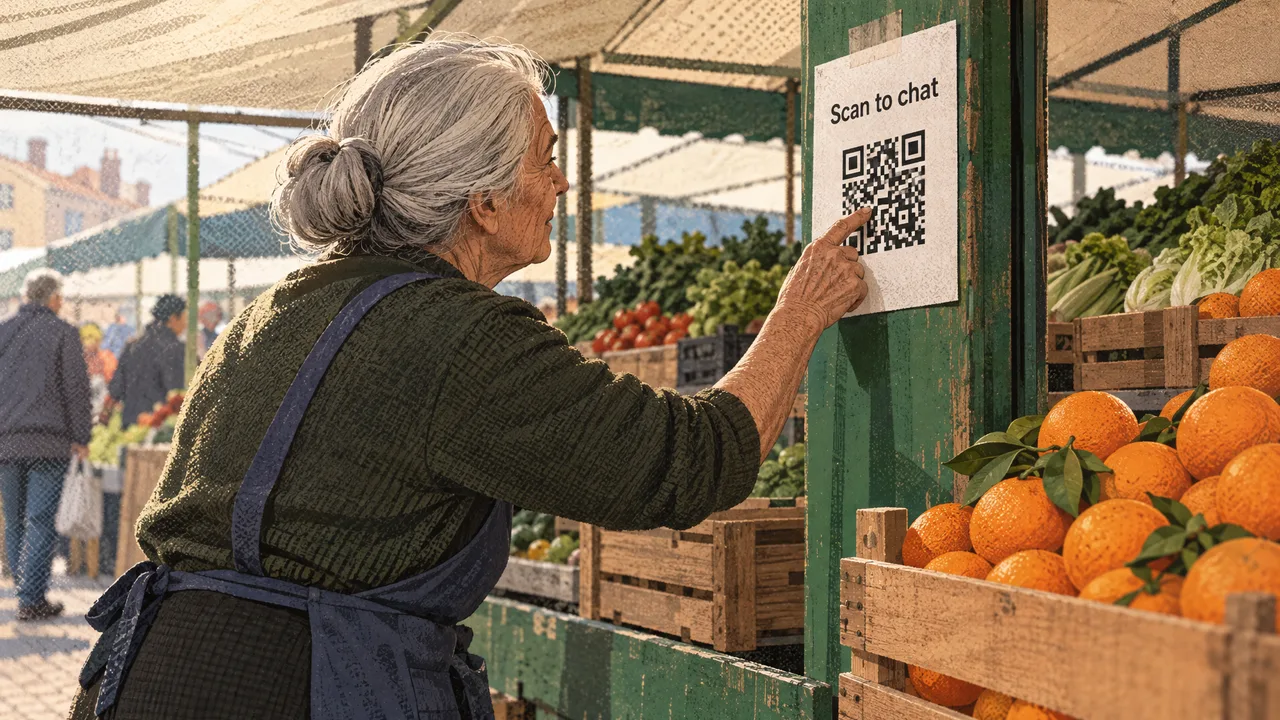
A WhatsApp direct link is a URL built on the wa.me domain or the api.whatsapp.com send endpoint that opens a chat with a phone number you specify, with an optional prefilled message carried in the address. It is not the same thing as a WhatsApp chat link used for group invitations, and it is not a QR code, though the two often get confused when a marketing team describes a campaign. The direct link points at a one-to-one conversation with a business number.
The mechanism has been stable for years, and it matters because WhatsApp is where a large share of your customers already spend their day: the platform now surpasses 3 billion monthly users (f.aa.com.tr). A direct link lets you meet them inside that app without asking them to install anything, sign up for anything, or remember a phone number.
Where it differs from adjacent tools matters for campaigns. A click-to-chat link on a website, an ad, or an email signature all use the same underlying mechanism but serve different traffic. The link answers "how do I send a link on WhatsApp that a stranger will actually tap," and the answer starts with putting the conversation one tap away. If you want a broader walkthrough of the different link formats and when each converts, our guide to the best methods for sending links covers the variants.
Anatomy of the URL Behind the Link
Two URL shapes do the work, and each has a specific job.
The first is the short form: https://wa.me/<number>. You replace <number> with the full international number, country code included, no plus sign and no spaces. Append ?text= followed by your prefilled message and the link arrives with the customer's reply box already populated. This is the form you want on a business card, a website button, or an email footer, because it is short enough to type and survives being read aloud.
The second is the longer send endpoint: https://api.whatsapp.com/send?phone=<number>&text=<message>. It does the same thing but tolerates a few more parameters and is friendlier to certain apps and platforms that mangle the shortened form. When a direct link fails on one channel but works on another, this is the shape to switch to.
The prefilled text is where most campaigns lose their advantage. Spaces become %20, ampersands become %26, and an emoji or accented character gets percent-encoded into a multi-byte string. If you type the message raw into a spreadsheet and paste the cell into a link, the message arrives truncated or garbled on the other end. Encode the text before you build the URL, test it on an actual phone, and keep the message short enough that the customer can read it before they decide what to say.
Country-code errors are the other silent killer. A number without its country code resolves to the wrong region or fails outright, and the customer sees an error page rather than your chat. The best way to avoid both problems is to stop hand-building links altogether. That transition from manual to structured is what we mean by stop copy-pasting and start strategizing for a direct-link program.
Building Your Business Link, Step by Step
- Write down the full international number you want the link to open, country code first, digits only, no plus, no spaces, no leading zero after the country code. This is the number that will receive every tap.
- Draft the prefilled message as the opening line of a conversation, not a paragraph. One sentence that names who you are and what the customer gets by replying converts better than a wall of text, and it survives encoding more cleanly.
- Encode the message for the URL. Replace spaces with
%20, ampersands with%26, and run the string through a percent-encoder before you paste it into the link. - Assemble the short form for public use:
https://wa.me/<number>?text=<encoded message>. Keep the longerapi.whatsapp.com/sendform as a fallback for platforms that break the short one. - Test the link on a real phone, on the platform you intend to publish it, with a number that is not your own. Confirm the chat opens, the message appears, and the send button is live.
- Publish the link where the customer already is: a website button, a QR code on packaging, an email signature, a paid ad, a Google Business profile.
- Route the replies. Before you publish anything, decide who answers, how fast, and in what shared view, because the link is now doing its job and the conversation is on you.
If the publishing step is where you keep getting stuck on formatting and prefills, the practical detail in stop pasting and start converting walks through the message side of the same build.
Signals That Separate a Converting Link From a Dead One
The link format is not the deciding factor. What separates a link that converts from one that does not is the state of the conversation it opens into, and that state is measurable before you spend money on traffic.
The first signal is whether the link passes a prefill that earns a reply. A prefilled message gives the customer an opening line they can send without composing one, which lowers the effort of starting. An empty reply box asks them to invent the first move, and most will not.
The second is whether the number behind the link is staffed by more than one person. A direct-link campaign pointed at one employee's phone creates a single point of failure: that person's lunch break becomes your response-time gap. Look at whether the number has a shared inbox view, assignment rules, and a timer that shows how long a conversation has been open.
The third is whether the reply carries context. When a customer taps a link from an ad, the business should know which ad, which page, and which campaign the click came from. A link with a prefilled message that names the offer, or a structured campaign tag, gives the answering agent something to work with; a bare number gives them a cold start.
The fourth is the tracking around the message. With per-message pricing now the model for the WhatsApp Business API (per BSG), the message that follows a click has a real cost, which makes a wasted click expensive. Watch whether you can tell a good click from a bad one after the fact.
The fourth signal is latency. A tap that lands in a queue answered hours later has already lost, regardless of how clean the URL was.
The Wastes That Kill Direct-Link Campaigns
Hand-typed numbers and truncated prefills are the quietest waste. A link built by copy-pasting from a contact card can carry a hidden character, a missing country code, or an unencoded space that breaks halfway through the message. The customer sees a blank chat or, worse, an error, and you never know. Build the link from a validated source and test each variant before a campaign goes live.
Pointing every campaign at one personal number is a second waste, and it hurts more as you scale. When five campaigns share one employee's WhatsApp, the responses queue behind that person and the attribution disappears. A shared inbox view with assignment rules keeps the number responsive and keeps the campaign source visible.
Skipping the prefilled message costs a measurable share of replies. A customer who taps a link with an empty box has to decide what to type, and many decide not to. The prefilled line does the deciding for them, and the prefill is also where you put the offer, the context, and the call to action in one sentence.
Publishing a direct link without a staffing plan is a fourth waste. The link drives volume; if nobody is assigned to answer within minutes, the campaign is generating conversations that will be closed by silence. The failure modes and the fixes are set out in our breakdown of why most people get it wrong, and the common thread is that the link was treated as the campaign rather than the door.
One more waste deserves its own paragraph: ignoring the scam context the customer brings with them. Meta banned more than 6.8 million WhatsApp accounts linked to scam operations between January and June 2025 (The Spokesman-Review), and consumers reported losing $425 million to scams that started on WhatsApp in 2025, second only to Facebook among social platforms (Federal Trade Commission data). A business link that opens without context, from a number the customer has never seen, now reads as suspicious to a wary audience. The prefill should identify you, and the route from the tap to an official, verified business profile should be short.
Choosing the Right Link Setup for Your Situation
You are choosing between three setups, and the right one depends on the volume and the stakes of the conversations you expect.
If you are a solo operator with a handful of inbound messages a week, a plain wa.me link on your website and profile is plenty. You will answer from the app, the prefill does the qualifying, and the volume does not justify a shared inbox. The link still needs the country code and an encoded message, but the moving parts are small.
If you are running paid ads, email campaigns, or anything with a measurable spend behind the link, the routing becomes the deliverable. You need a number that multiple people can answer, a view that shows which campaign each chat came from, and a way to see response time. The conversation the link opens is now a pipeline, and a pipeline needs an owner.
If your customers already message you on WhatsApp and the conversation spans pre-sale, purchase, and support, a direct link is simply the entry point into an ongoing relationship. The link needs to route into the same place every time, with the history intact, or you will keep re-asking the customer who they are.
The signals that settle the choice are simple. Count how many conversations you can realistically answer in a day. Count how many people need access to the same number. Count how many channels you will publish the link on. If any of those counts exceeds one, the manual setup will cost you more than the link ever saved.
About WhatsBox
We run the WhatsApp Business API as a shared team inbox with session timers and assignment, so a direct-link chat does not land on one person's phone and die there (O3, O10). The number stays responsive because the queue is visible and the ownership is explicit.
Our bulk broadcast campaigns via WhatsApp Business API reach opted-in contacts, and our custom-trained AI chatbots with a knowledge base handle the common questions before a human steps in (O4, O5). That combination means the click you paid for is answered, even outside office hours, and the customer who taps a direct link always lands in a live conversation.
A human-in-the-loop escalation hands the complex queries to a person, and our workflow automations via embedded Zapier integration pull customer data from Google Sheets and Google Forms into the conversation so the agent is not starting cold (O7, O8, O12, O13). Our whitelabel WhatsApp chat widget for websites turns a visitor into a direct-link conversation without leaving the page (O9).
Who should look elsewhere: if you answer a handful of WhatsApp messages a week from a single phone and have no plans to grow that volume, a plain wa.me link and the WhatsApp Business app will do the job without any of the routing. The free app is enough for that scale (App Store listing). Our pay-per-use tier, currently free during beta with no seat fees, no user limits and no contracts, is built for teams that need the inbox, the AI, and the routing together. If that describes you, get in touch or check the current pricing for the live numbers.
Frequently Asked Questions
How do I open a link directly from WhatsApp?
A link inside a WhatsApp chat is tappable, and tapping it opens the destination in your device's browser or the in-app browser, depending on your settings and the link. If the link does not open, copy it, paste it into a browser, and check whether the sender's chat has any content restrictions. For a wa.me link, tapping it opens WhatsApp's chat screen with the number and prefilled message, and you confirm with the send button.
What is WhatsApp direct message?
A WhatsApp direct message is a one-to-one message sent to a specific number, as opposed to a message in a group. The "direct" part refers to the private chat between two parties. A direct link is the URL that opens that private chat, and a direct message is what you send once you are inside it. The terms get used interchangeably in marketing, but they describe different things: one is the door, the other is the conversation.
Can someone link my WhatsApp without me knowing?
Someone can build a wa.me link pointing at your number without your knowledge, because the link only encodes your public phone number. Opening that link does not connect to your WhatsApp; it opens a chat with you from the other person's account. What they cannot do is read your messages or access your account through a link. Suspicious messages from unknown numbers asking you to click a link and verify your account are a phishing pattern, not a link vulnerability. Keep two-step verification on, and report unsolicited links that ask for codes.
What is a WhatsApp chat link?
A WhatsApp chat link is the general term for a URL that opens a WhatsApp chat. It covers two different things: the direct link, which opens a one-to-one conversation with a specific number, and the group invite link, which opens a group chat. The direct form uses wa.me and a phone number; the group form uses a chat.whatsapp.com invite code. For business use, the direct link is the one you publish, because it routes a stranger into a conversation with your team rather than a group they were not invited to.