
WhatsApp Business Short Link: What the Redirect Hides
A WhatsApp business short link is a redirect on a domain you control that points at a wa.me or api.whatsapp.com address, counts the tap, and then hands the visitor to WhatsApp, where the conversation itself begins. Most guides treat the shortening as the job. We think the redirect is the smallest half of it.
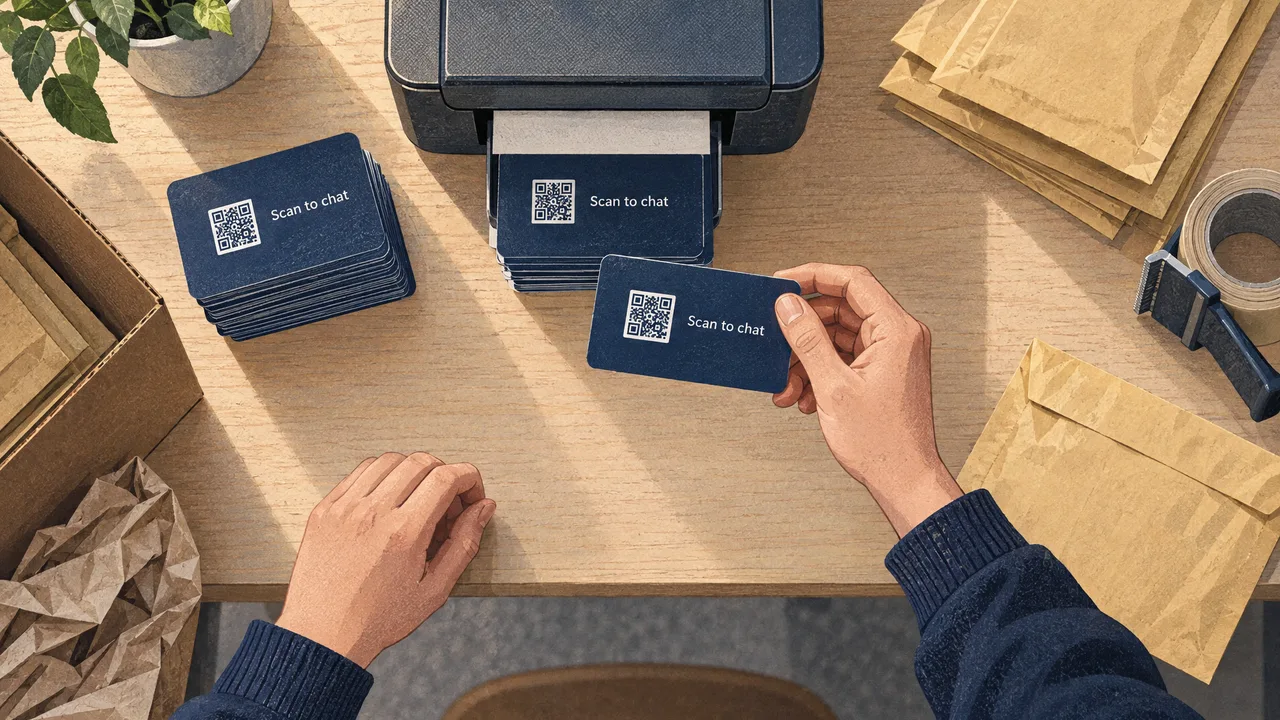
That claim is worth spelling out. The link layer records a tap and nothing more: no name, no intent, no thread. Everything a business actually wants to know about that person is created in the chat that opens after the redirect, and only if a system is watching that chat. Build the short link well and you have bought yourself a cleaner URL and a countable click. Build the inbox behind it badly and the count is the only thing you will ever have.
What the Redirect Does Before WhatsApp Opens
A short link is three hops pretending to be one. The visitor taps yourbrand.co/offer, your redirect service logs the request with a timestamp, a referrer, a user agent and whatever campaign parameter you appended, and issues a 301 or 302 to the real wa.me URL. The browser follows, WhatsApp resolves the phone number, and either opens a chat with a prefilled message or shows the app-install prompt on desktop.
Nothing about that chain is proprietary. You can run it on a branded domain through your own hosting or a link-management service, and the only thing the shortener contributes is the record of the tap. The number in the wa.me path does the actual routing.
This is also where the free-conversation allowance sits, and it is worth knowing before you plan volume. When you use the WhatsApp Business Platform, your first 1,000 service-related conversations are free each month, with message threads back and forth during a given period counting as one conversation, per WhatsApp Business. That allowance applies to the conversation, not the link, so the short link's job is to start conversations you can afford to have.
The gap opens at the seam between the two systems. Your redirect knows a browser tapped. WhatsApp knows a phone number opened a thread. Nothing automatically joins those two records unless you put an identifier in the prefilled message, and the prefilled message is editable by the person you sent it to.
Where the Abstraction Leaks
The usual failure is a campaign link built as wa.me/1234567890 with no context, shared in a print ad or a QR code, then evaluated a week later against a spreadsheet. You can see that forty people tapped. You cannot see which forty, what they asked, or whether anyone replied before the session window closed.
Three structural causes sit behind that. The redirect layer and the messaging layer are owned by different systems with no shared key. Shortened domains are treated with suspicion by recipients who have been trained to distrust them. And the link, once tapped, drops the visitor into an app where your tracking pixels do not follow.
That second cause is not hypothetical. Link shorteners hide the destination, which is exactly the property phishing relies on, and the same tidy URL that makes your brand look considered makes a wary customer hesitate. The link is honest; the format has a reputation problem inherited from people who abuse it.
Raw wa.me links have the opposite problem. They are transparent and trivially inspectable, which is fine for a one-to-one introduction and useless at campaign scale, because the only volume signal they generate is whatever lands in the inbox. If you want to understand how much of this sits in the URL layer itself, our breakdown of what a WhatsApp URL actually builds follows the same seam from the other side.
Building One You Can Measure
The order matters, because a short link built before you know what the inbox records will count taps you can never attribute.
- Register a short domain you own, ideally a subdomain of the site customers already recognize, and point it at a redirect service you can query for click logs.
- Decide the destination: a plain
wa.menumber for inbound enquiries, or anapi.whatsapp.com/sendURL with atextparameter carrying a prefilled first message. - Put a campaign token inside that prefilled text, something like a short code the customer leaves in place, so the first inbound message identifies which link produced it.
- Append UTM parameters to the short link itself so the redirect log captures source and medium before the hop to WhatsApp.
- Route the resulting conversations into a shared inbox with assignment, so the thread carries an owner rather than sitting in one person's phone.
- Test the full chain on a desktop browser and a phone, because the desktop path shows an install prompt that the mobile path never does.
Step three is the one teams skip, and it is the only step that bridges the redirect log and the conversation record. Without it you have two datasets and no join key.
The Mistakes That Cost You Attribution
Prefilling a message the customer cannot see the purpose of is a quiet way to lose the token. If the text reads like boilerplate, people delete it before sending, and your campaign identifier disappears with it. Write the prefilled line as something the customer would want to send, and treat the code as a natural part of it.
Reusing one short link across every channel is the second attribution killer. A single URL in an email, a QR code and a paid post tells you the total and nothing about which channel paid for itself. One link per placement costs you nothing and answers a question a combined link can never answer.
Pointing the redirect at an unofficial gateway is a different category of error. If the destination number is not connected to the official WhatsApp Business API, you get the messaging behavior of a personal account: no verified business profile, no template messages, and a real risk of the number being restricted when volume climbs. The short link will work perfectly while the account behind it fails.
Letting the redirect chain run through three or four hops is the last one. Each intermediary adds latency and removes a referrer, and mobile browsers frequently drop the chain partway, so the visitor sees a blank page instead of WhatsApp. One redirect, one destination.
What the Loss Numbers Say About Hidden Destinations
Shortened links carry a real trust cost, and the fraud data explains why recipients flinch. In 2025, nearly 30% of people who reported losing money to a scam told the FTC it started on social media, with reported losses reaching $2.1 billion, and the FTC names WhatsApp groups among the tactics used in investment scams, per the FTC's social media report.
That context changes how you should present a short link. A domain the recipient has never seen, arriving in a forwarded message, reads as a risk. A domain that matches the brand they already follow reads as normal. The recommendation that falls out of the data is unglamorous: use a recognizable domain, say in the message what the link goes to, and never send a bare shortened URL with no accompanying sentence.
Scam volume also explains why platforms police this space hard. Meta banned more than 6.8 million WhatsApp accounts linked to scam operations between January and June 2025, as reported by The Spokesman-Review. A business that runs legitimate, opt-in campaigns through the official API is not the target of that enforcement, but the enforcement sets the baseline your customers apply when they see a link.
How WhatsBox Closes the Loop After the Tap
The redirect ends at the chat, so the platform behind the number is where a tracked click becomes a countable outcome. WhatsBox runs on the official WhatsApp Business API, which means the number your short link points at is a verified business number rather than a personal account, and approved Meta templates sync into the tool so outbound campaigns can follow up on inbound taps.
The shared team inbox with session timers and assignment is what makes the token worth collecting. A conversation arrives, gets an owner, and carries a visible window before the free service period closes. Bulk broadcast campaigns send approved template messages to custom contact lists and track delivery history, so the follow-up to a tapped link has its own record. When a query outgrows the AI, escalation sends the team a push notification so a person takes over. That is the mechanism that turns a click into a conversation, which is why we treat the click-to-chat link is the smallest part as the right starting assumption.
Our own fee and Meta's are separate, and keeping them separate is the only way to read a campaign's cost. WhatsBox charges $0.0025 per incoming or outgoing message with no seat fees and no user limits. From October 1, 2026, Meta charges for service messages once a business phone number has sent 1,000 free ones in a month. Both apply; neither replaces the other.
Putting a branded short link on a number backed by an official API is the combination that makes the redirect measurable end to end. Whitelabel is the embeddable WhatsBox inbox for agencies, IT providers and SaaS founders, a separate product from the free WhatsApp website chat widget. You can see what the plan covers on our pricing page, and if you want to talk through the link-to-inbox chain for your own setup, get in touch.
Frequently Asked Questions
How do I create a short link for WhatsApp Business?
Build the destination first, then shorten it. Compose the wa.me or api.whatsapp.com/send URL with your business number and an optional text parameter for the prefilled message, then create a redirect on a domain you own that points at it. Use one redirect, keep the target on the official API, and append UTM parameters to the short URL so the redirect service logs the source. The shortlink is your infrastructure; WhatsApp only handles the final handoff to the chat.
How do I shorten a URL in WhatsApp?
WhatsApp has no built-in shortener, so the shortening happens before the link ever enters a message. You either run a redirect on your own domain or use a link-management service, then paste the resulting short URL into the chat, caption, or broadcast. If you send through the Business API with template messages, the short link lives in the template body and must pass approval with the rest of the text. Editing a link after approval means resubmitting the template.
Can a short link tell me who clicked it?
No. The redirect log records a tap, a timestamp, and whatever parameters you appended, but it never sees the WhatsApp identity behind the open. If you need the click tied to a conversation, carry a campaign token inside the prefilled message and let the first inbound reply identify the source. The link starts the thread; the inbox is where the thread becomes attributable.
Sources
Build a WhatsApp Click to Chat Link That Lands in a Team Inbox
Choose which number and which inbox should receive the conversations your link starts, then build, test and place a link that holds up.
Using a WhatsApp Link Generator That Tracks Every Chat
Decide what each click-to-chat link should say before anyone taps it, so your team can tell an ad lead from a packaging scan. Then choose where those chats land.